
Lionel Davidson, Alien Contact and the Philosophy of Anomalous Experience
A Vision Before Its Time
In 1980, British novelist Lionel Davidson, best known for his crime thrillers, published an uncharacteristic children’s novel: Under Plum Lake. On the surface, it is a whimsical story about a 12-year-old boy who, exploring a sea cave, stumbles upon a hollow earth utopia beneath the ocean. But read closely, Under Plum Lake is something else entirely: a visionary parable about the trauma of anomalous experience, the ontological shock of encountering an alien reality, and the loneliness of returning from it with no one to believe you.
Though disguised as a children’s fantasy, Davidson’s narrative alludes to a literary lineage of adult hollow earth mythology. Egonia, the subterranean world Barry encounters, echoes a long tradition of secret civilizations accessible only through descent—tracing back to Bulwer-Lytton’s The Coming Race, the occult legend of Agarttha by Saint-Yves d’Alveydre, Willis George Emerson’s The Smoky God, and Ferdinand Ossendowski’s Beasts, Men and Gods, among others. These earlier works envisioned utopian societies hidden beneath the surface, spiritually, politically, and technologically superior, and available only to initiates.

The novel is oddly prescient in the way motifs that would only come to dominate anomalous discourse years later converge in it. Under Plum Lake anticipated the emotional and structural patterns of alien abduction narratives—mind control, time distortion, memory suppression, and post-contact discombobulation—all written before these defining features were coded as common elements. Davidson also forecast the interpretations of dream diaries to excavate buried memories, and the emphasis on emotional intensity of those memories as an indicator that something real had caused them. The novel also anticipates the alignment of the alien abduction experience with the shamanic framework outlined by scholars like Mircea Eliade, a connection only made years later by researchers who considered it to be its nearest match.
Davidson located his alien world not in the heavens, but beneath the sea. This reversal is another compelling antecedent to a modern fixation: that UFOs may originate not from deep space, but from the depths of our own planet, a hypothesis that has been around for decades and is now gaining cultural traction as UAP1 researchers muse about “transmedium” craft and alien bases under the ocean floor. In choosing a sea cave as the entry point to another reality, Davidson reverses the vertical trajectory of space-age imagination. However, as above, is not the same as below—down there is superior, and ancient.
It’s here that the novel also anticipates a second thread of cultural fascination resurgent in recent years: the lost civilization mythology—the same fascination that has driven the popularity of The History Channel’s Ancient Aliens, figures like Graham Hancock and big budget Netflix shows like Ancient Apocalypse. It’s the belief in ancient, technologically advanced human (or nonhuman, intelligent) civilizations erased from history. These themes, now ubiquitous in speculative history and pseudo-archaeology, are present in Under Plum Lake. In brief and easily overlooked sentences, Davidson describes not one but half-a-dozen antediluvian lost civilizations, ancient astronauts, and lost nuclear mastery as ancient as fire—any one of these ideas could easily justify a short story of their own. Instead, each is fleetingly flashed at the reader like a magician fanning cards before a trick. As a result, it reads like an index of fantastic concepts and allusions never developed into plot points.
Under Plum Lake deserves a reappraisal as part of the canon of anomalous experience literature, but also as a unique example of the recycling and cultural transmission of ideas from literature to real life experiences. By analyzing its structural and thematic parallels to UFO contact reports and visionary journeys published before it—like that of Betty Andreasson—and by comparing it to lesser-known narratives like Margaret Rogers’ letter I Have Been in the Caves, (more on that later) we can see how it plays its part as a well of ideas available to the contact movement that sprang up after its publication—such as that of Alan Godfrey—and we can reposition Davidson as an unsung prophet of what would become a dominant pattern in post-1980s contact literature.
Lionel Davidson
Lionel Davidson (1922-2009) was a British writer of crime novels and thrillers. Born in Hull, Yorkshire, to Russian and Polish immigrant parents, he was the youngest of nine children. He began his career as an office boy at The Spectator magazine, where he was able to read unsolicited manuscripts sent to the fiction editor. He had an interest in fairytales and became a freelance story writer, reported for the Keystone press agency, and served as a telegraphist for the Royal Navy’s submarine service. Later, he became fiction editor of another political magazine, John Bull, a position he held for eight years from 1955.
His first book, published when he was 38, The Night of Wenceslas (1960) was an immediate success winning the Author’s Club, Best First Novel Award. It was adapted for film, becoming Hot Enough for June (1964) starring Dirk Bogarde.

Remarkably, he wrote his next novel The Rose of Tibet (1962), which was praised for its realism detailing an adventurous trip across the country, by relying solely on research and deliberately harking back to Victorian adventure stories for inspiration—he never visited Tibet.
By the time Davidson published Under Plum Lake in 1980, he was already a literary success, having won three Crime Writers’ Association Gold Dagger awards.
There are few interviews with Davidson, and those that do exist don’t shed much light on how this book came about. We have to make do with the little Davidson does reveal about his writing rationale more generally. He expressed a keenness for riddles and niche humour and considered it a winning formula for a story to involve a quest. He also argued there should be: “some piece of mischief working its way out in the story,” and part of the prerogative of a writer is to be “a bit tricky…a tease!”2 folding obscure riddles into their work.
This he demonstrated this in his crime novel, The Chelsea Murders, where literary allusions form a game played by the killer, who leaves cryptic quotations taken from famous Chelsea writers to taunt the police with hints as to who the next victim will be.
Under Plum Lake is similarly cryptic. Davidson played a similar game, this time making subtle allusions to unnamed works from science fiction, folklore, ufology and occult ideas. These references are never named outright and the result is a text that behaves like a riddle, inviting us to unravel its mischievous message about anomalous experience.
Under Plum Lake in Synopsis
The story follows 12-year-old Barry Gordon during a family holiday where they rented a dilapidated house on the Cornish coast. He has two sisters, Sarah, 17, and Annie, 9, but his story is his alone. A few days after a miraculous escape from drowning in the sea he’s drawn inexplicably to continue his exploration of what he calls a rabbit hole leading to a sea cave. On a moonlit night he sneaks out of his bedroom window, and guided by a sudden intuitive knowledge locates a submerged tunnel. Inside he is greeted by Dido (“Deedo”), a boy with white hair and green eyes who appears the same age but is actually 99. Dido is a native of Egonia, a vast, technologically advanced subterranean utopia. Unbeknownst to Barry, his previous escape was not an accident. Dido had been watching him and deliberately rescued him from drowning because he had plans to take Barry to see the real world. He touches Barry on the forehead causing a momentary headache, rendering him passive. It is an abduction.
He leads Barry to a canoe that illogically contains a large interior room with a sofa along one wall, carpet on the floor and music softly playing. It speeds them into the hidden realm beneath the sea, and through its transparent hull Barry sees forest clad hills and rolling meadows, a fabulous city with colourful palaces of crystal, flying cars protected by magnetic fields—and giants. Above them is a luminescent artificial firmament adorned with its own planets and stars.
Dido tells Barry that he does not come from outer space, but “inner space.” He outfits Barry with Egonian clothes, gives him a rejuvenating drink, and ushers him into a society that reads his thoughts and alters his feelings with a mere touch. Dido can silence or subdue him at will.
Egonians can manipulate light, time, and mind with casual mastery. They live for 700 to 800 years. Their childhood lasts nearly a century, their university education begins at 180, and their brains grow slowly and powerfully. They are a different species—vegetarian, physically elite, transhuman in their evolution, and telepathic. Some have trained to become “powerlines for space energy,” telepathically navigating ships and operating factories in space (more ideas never fleshed out in the novel). They don’t experience pain or illness and do not age or suffer as humans do.
Barry is both guest and specimen. Dido, son of the President of Egonia, parades him at parties, where giants toy with his body and mind. He visits the “pleasure dromes” and is plunged into an immersive holographic spectacle, baffled by a three-dimensional projection of himself. He’s taught to ski magnetized mountains, flies using a personal electronic glider, and ingests fruits that induce euphoria and hallucination. Egonia is designed for extreme sports and extreme pleasure. Despite knowing the dangers, Dido is negligent; Barry loses control, crashing and killing himself. He has an out of body experience. He sees Dido standing over him as other figures surround his broken body. He sees Egonian doctors remove his brain.
This event marks a change in Dido, he absorbs Barry’s pain3—a sensation entirely new to him—and feels remorse over Barry’s death. Seeking forgiveness, he becomes Barry’s guardian angel. He pities Barry, who, like all surface dwellers, is considered developmentally stunted—they typically “died while they were children, with children’s minds”4—he is now determined to protect him and show him more than anyone ever has seen. He loves Barry.
Dido reveals deeper secrets: Earth’s civilizations are the outermost crust of something much older. Humanity, he explains, lives on the “skin of an apple.”5 In Earth’s long history half a dozen civilizations have risen and fallen. Long ago, a global catastrophe—the “mess up”—was triggered when one of those civilizations tried to shift Earth toward another star using solar energy. The result shattered the planet’s crust and reformed the continents. Those who survived retreated underground.
Dido defies Egonian law to reveal these truths to Barry, inundating him telepathically with answers to questions Barry didn’t know to ask. Barry views his own birth, his early life, and understands the world as an immense, structured consciousness. The Earth, he is told, is a brain. The universe, a system of intelligence. There are larger godlike minds—though Dido humbly admits that in his almost century of education he “hasn’t done God yet.”6
Normally, surface visitors are erased—memories wiped clean and they’re returned to their beds by the morning, but Barry is the singular exception. He is erased. But not entirely. Specialists implant false memories to account for the missing time, but Dido, breaking the rules again, preserves fragments of Barry’s true memory. Just before the end of Barry’s stay—only three days on the surface but weeks below—Dido brings him to “The Abyss,” a black hole-like void beneath Egonia, under Plum Lake. It’s revealed as the source of creation—“the world creating itself.” Barry sees what he’s not supposed to see, a pillar of Holy light shining visible even through closed eyes.
Then Barry is returned to the sea cave and rescued by a search party. Back home, he is weak and delirious, and changed: he’s depressed, has vivid dream journeys, calls out in his sleep, he writes them in secret, they contain something real. He creates a shrine in the cave where he first met Dido. He knows, without proof, that he has lost something real. He returns to that place every night, hoping the contact will happen again.
Mischief: Barry Gordon and the Structure of Alien Abduction
This sequence – ascent (as we’ll see Davidson flips the traditional arrangements, they first descend but then emerge soaring above the inner world), contact, erasure, and trauma – closely mirrors what folklorist Thomas E. Bullard in a comparative study of over 300 documented cases,7 later identified as the eight-phase structure of alien abduction: Capture, Examination, Conference, Tour, Otherworldly Journey, Theophany, Return, and Aftermath.
Davidson’s novel includes all eight stages, but was written years before Bullard published his findings in 1987. Barry is captured (drawn to the cave, taken aboard an impossible craft), examined (studied, probed telepathically, surgically repaired), guided (taken on a tour of Egonia), given metaphysical revelations (In the Pleasure Dromes and the Abyss), and returned with near total amnesia. In the aftermath he suffers from what would later be called post abduction syndrome8 and ontological shock – the psychic trauma of realizing the nature of reality is nothing like what one believed.
It may be that the structure Bullard uncovered is archetypal, having always existed, but for Under Plum Lake to include every phase is remarkable. Davidson wrote it in the late 1970s at that time the modern abduction phenomenon had only a handful of high-profile cases: Betty and Barney Hill, Travis Walton, and Pascagoula. Although 1979 was a bumper year for new abduction reports, the key themes of trauma, memory fragmentation, and recurring dreams would not dominate abduction literature until the mid 1980s and beyond, reaching the mainstream with Budd Hopkins’ bestselling book Missing Time: a documented study of UFO abductions (1981), Whitley Strieber’s blockbuster autobiographical abduction account, Communion (1987), Intruders: the incredible visitations at Copley Woods by Hopkins (1987) and then, in the 1990s, Secret Life: Firsthand Accounts of UFO Abductions by David Jacobs (1992), and the media adoration of the telegenic Harvard professor of psychiatry Dr. John Mack with his earnest study, Abduction: Human Encounters with Aliens (1994).
Yet, Davidson somehow foresaw the motifs that would define the UFO abduction literature explosion of the 1980s and ’90s: The guide figure in Under Plum Lake, Dido, is part Virgil, part alien handler. Though ultimately affectionate, he is at first manipulative, controlling Barry’s mind and body. This ambivalence mirrors numerous contact narratives in which alien beings initially exert power—often examining or subduing the abductee—before offering visions or cryptic advice.
Barry experiences time distortion: while he spends weeks in Egonia, only three days pass on the surface. This reverses the typical supernatural passage of time trope of folk tales, such as that of brothers Llewellyn and Ryhs. Ryhs steps into a fairy ring and begins dancing with some small humanoid creatures. When he’s eventually rescued he believed he’d only been gone five minutes when in fact a whole year had passed. Barry experiences the longer timeframe in Egonia, perhaps indicating that the “real” world is the one below. The mismatch between experience time and real world time is an often reported aspect of alien abduction reports, like that of Travis Walton, who believed he had been gone for five hours but had actually been missing for five days.
Barry frequently loses consciousness or becomes paralysed, only to awaken in a new and unfamiliar place. His memory is erased, but not completely. Like the abductees studied by Hopkins, Jacobs, and Mack, he is haunted by recurring dreams and flashbacks, slowly piecing together the submerged truth. The book itself is a journal of these recovered memories. Even the Egonian technology mirrors the dream logic of abduction accounts: the “canoe” Dido pilots is a surreal transmedium craft—simultaneously submarine and aircraft it changes shape while they are inside it—impossible by Earthly standards, yet consistent with descriptions from abductees who describe bizarre interiors and transitions that defy physical logic.
Barry’s emotional state on return is one of dislocation and loss. He is more alone than ever, burdened with knowledge his sisters and parents can never comprehend. To him, the surface world feels “childish and ignorant.”9 His teachers are dull, his old life trivial. He has seen the world creating itself, and now he has to do homework.
The most insidious violation, however, is psychological. Dido’s flickering eyes read, write and erase data in Barry’s mind. This kind of staring procedure would also form part of the pattern of the aliens’ psychological domination that David Jacobs in Secret Life would later name “Mindscan.”
What sets Under Plum Lake apart from other children’s adventure stories is its literary voice, it is not triumphant. It is unsettling and mournful. Barry does not solve a mystery or escape with new powers (at least that he is aware of). He is a broken vessel, desperately recording dreams in a diary, seeking one clear and concrete piece of evidence that would answer whether he is mad or enlightened.
The Critics
Under Plum Lake polarised the critics. In autumn 1980 The Daily Mail praised it as “The children’s story of the year,” and elsewhere it was listed among the years’ best science fiction stories. British and American newspapers published positive reviews, celebrating it as imaginative and inventive—a suitable adventure story for the precocious child. Yet, these reviews were brief and one-dimensional, focussed narrowly on the book’s surface genre elements, offering little exploration of its deeper meaning or implications.

One insightful review by Anstiss Drake, for the Chicago Tribune, made some inroads into detecting the books’ symbolic literary references, drawing a parallel with Coleridge’s famous, and famously opium-inspired, poem Kubla Khan with its images of (similarly spelled) “pleasure domes” and yearning for a lost paradise. But, likely due to copy constraints, her analysis ended there. (However, one of the goals here is to continue to untangle Davidson’s choices).

The longer the reviews, the more negative they were. Critics who got their teeth into the book realised they really didn’t like its taste. Some were openly hostile, faulting Barry Gordon’s undeveloped character and the gaudy and uninspiring portrayal of Egonia. Its ageless, pain-free inhabitants live in luxury, consuming psychedelic fruit and enjoying endless leisure. This shallow hedonism seemed pointless and nothing to envy.
In a review titled This Fantasy is Forgettable, one critic was baffled by it, writing: “What a child is supposed to gain or understand after reading this book is impossible to identify.”10 Another reviewer, offended by the book’s lack of a clear moral framework, even suggested it might be worthy of burning:
When a story presents the rewards of pleasure or success in ways that can be bought it is time to become concerned. When the beings of the created world are smarter or more evolved than humans and as a result have no need of each other; when mind control of others is acceptable; when the only good is a kind of dreadful, dangerous fun, then I believe that book burning is probably justified.11
Was Under Plum Lake a Banned Book?
Negative reviews like these likely inspired rumours that Under Plum Lake had actually been banned. This is not true, it has been in print with various publishers since its first edition.12 However, its ambiguous tone and complex themes make it difficult to classify as a standard children’s book, and it’s plausible that 13-year-olds—the age of protagonist Barry—might be steered away from it. The relationship at the heart of the story is complicated—if not actually abusive. Barry is treated poorly by Dido, like a pet he is manhandled and manipulated. He’s fed hallucinogens and warned that the levels of ecstasy available in Egonia might literally “burst” his brain, then he’s clumsily allowed to kill himself.

A Story Without a Moral?
Barry dies—his heart stops—and in an out of body experience he watches his brain removed from his body during a surgical resurrection. Upon recovery, he is reprogrammed with false memories and returned to the surface, disoriented and alone. Without deeper analysis you’d be forgiven for thinking that Barry Gordon had been, as Charles Fort phrased it: “fished for”13 by superior beings, and left worse off than before. But there are subtle hints that there is a purpose to his experience. Barry is physically sick as a dog when realising the magnitude of his loss, saying:
A fantastic thing had happened to me that had not
happened to anyone else in the world, and I didn’t
know what to think.
I couldn’t tell anyone. It wouldn’t help if I did, and
I didn’t have enough to tell, anyway. I had a few
pieces of a jigsaw that needed hundreds of pieces. I
didn’t know where to put the pieces I had.
I wasn’t the only one who’d been to the other
world. He’d [Dido] told me that. But I was the only one to
remember it, and I wondered why.
That’s what I thought in the end. I thought: why?14
What was Davidson trying to say?
If Barry is left worse off than when he began, as it first appears, what moral or message was Davidson aiming for that the reader might take away?
Unlike his earlier children’s novels, written under the pen name David Line, Soldier and Me15 (1966) and Mike and Me (1974) which are grounded, realistic stories that have adolescent friendship at their core and a distinct moral message about loyalty and courage, Under Plum Lake offers no easy resolution. Davidson’s only science fiction work presents a more ambiguous relationship with Dido at first mistreating Barry before their bonding. As a trilogy of sorts the book could alternatively have been called Dido and Me, but instead the title Davidson’s uses is a misdirection, steering us toward a place of revelation, rather than a complicated relationship.

The story concludes with Barry, our narrator, having his worldview shattered beyond repair. Davidson again refuses to play by established rules. The antagonist in this story is Barry’s own mind and its limited facility to recall details of what he’d experienced. The book, a diary of his recovered memories, is his best effort to come to terms with that limitation. Davidson may have not been offering a moral at all, but a message about the cost of visionary knowledge, and the loneliness of remembering what no one else can.
Shared Experiences
Under Plum Lake continues its break with the tradition of children’s stories about the transit to other realms and of adventures with extraordinary companions. Some kind of shared experience is usually part of the arrangement, unless—as with Lewis Carroll’s Alice, who has the luxury of waking up from her adventure down the rabbit hole to Wonderland—it was all a dream. For example, the Pevensie children have each other to validate the reality of their passage through a portal in the back of a wardrobe to Narnia. There are Five Children and It who share a magical experience in E. Nesbitt’s story about a wish granting sand fairy. Wendy has the shared understanding of her family, who have their own experience of Neverland and of Peter Pan, “the boy who never grows up.”16 Matthew Gore—a boy singled out by an extraterrestrial consciousness in John Wyndham’s Chocky (1968)—shares an experience with his father who speaks with Chocky when she takes possession of Matthew, removing any doubt that an external force really did intervene to upend their lives.
But, again, Davidson did not follow the established pattern. He created an experience for Barry, and it seems unusually cruel that, although he’s certain that he traveled to another world and met strange beings, Barry feels unable to share this with anyone and is left to process the experience alone. But why? The answer lays beyond the distraction of the science fiction and fantasy elements and the extreme sport action sequences (chapters which hold up less well than the rest of the book). With the certainty that Davidson was no hack writer, we can see that his book is actually a carefully composed meditation on anomalous experiences, prophetic in structure and psychologically precise in its portrayal of wonder and aftermath.
Davidson’s Clues
Philosophical Questions of Experience
Plato’s Republic
If Davidson left clues in Under Plum Lake about this larger ambition—as his killer does in The Chelsea Murders—the first can be found in its opening line:
I went down again last night. I go every night now.
It describes Barry returning each night to the cave room, hoping to see Dido again. This line seems an unmistakable reference to the first sentence of Plato’s The Republic:
I went down to the Piraeus yesterday with Glaucon, son of Ariston…
Kateben (Greek) is the first word of the Republic and it also means “I went down.” It seems unlikely this echo is coincidental because of the deeper meaning of its philosophical allusion. Davidson appears to be “a bit tricky” here, planting a clue to a sophisticated symbolism at the very start of his novel that would likely be lost on its juvenile audience.
The lines describe a comparable geographical scene and invoke the ancient Greek fascination with caves as potent symbols of transcendence toward greater knowledge. Plato’s opening depicts Socrates going down to the Piraeus—the port of Athens. He’s descended from the high mindedness of the city to the bustling and seedy port to discuss justice and the definition of the good city. Along the way, he proposes a theory of knowledge positioning human experience along a line between illusion and reality; famously illustrated by the allegory of the cave.
The cave allegory17 is frequently invoked to describe an inadequate worldview and offers a glimpse of what it means to escape its confines. It asks us to imagine all humans as prisoners who have been shackled since birth so that they can only gaze at the back wall of a cave. Behind them are puppeteers who manipulate objects whose shadows are cast by firelight against the wall in front of them. Since the people are unable to turn their heads these shadows and the reverberating voices of the puppeteers are all they perceive of reality. They are so far from seeing the world as it really is that all they experience are shadows of artificial objects cast by dim light.
In this analogy one prisoner is unshackled and forcibly taken up out of the cave to see real objects. This new revelation would happen gradually, the prisoners’ eyes needing to adapt to the brightness of the world above. Eventually he witnesses the sun itself. Plato described how disoriented this prisoner would be when taken back into the cave; returning to an inferior world of illusions. The other prisoners would likely disbelieve and mock his attempts to explain his forced awakening.
Davidson—not for the first time—inverts the structure. Instead of being taken upwards out of a cave Barry Gordon is taken into one, descending through layers where he’s challenged to comprehend increasingly fantastic truths. Egonia itself resembles Plato’s ideal city: the perfect community where people live like the philosopher-kings of The Republic, spending centuries perfecting every aspect of their knowledge, and living without conflict or pain—even their cars can’t crash.
Eventually, Barry, unshackled from his surface life, tumbles weightlessly into “The Abyss,” to witness a shining Holy light, a mirror of the prisoner’s ascension toward the sun. Its symbolism as the centre of creation and the origin of life is the same.
Davidson also chooses to return Barry to his surface life, not by having him wash up on the beach, as he does during his first unsuccessful attempt to explore the cliffs, but by placing him on the shelf at the back of the sea cave, just as the cave dweller in The Republic18 descends back to his position of imprisonment, passing by the “raised way,”19—a shelf from where the puppeteers operate their marionettes.
It is no wonder, then, when Barry is returned to his normal life and the dilapidated house by the sea he feels disconnected from his normal life and begins to fail at his schoolwork. Like the returned prisoner he has no time for the petty affairs of humans. He sees his parents through new eyes, saying, “I know more than they’ll ever know,”20 and is now solely focussed on understanding what happened to him.
Clues to Science Fiction
As reviewers noted, the world that Davidson created for Under Plum Lake is imaginative and richly conceived. But, its building blocks—its nuts and bolts—are clearly derived from classic literature, popular science, science fiction, folktales, and stories of occult knowledge. This also suggests that world-building was not Davidson’s primary goal. Rather, he borrowed elements to construct a kind of thought experiment framed as a children’s adventure.
A Guide Figure
A key part of that structure is the relationship between Barry and Dido, who acts as a guide figure. In many foundational texts, such as Plato’s dialogues, The Aeneid, Orpheus and Eurydice, and The Divine Comedy, a guide or companion of alien superiority leads a neophyte on a transformational journey. This motif also appears frequently in science fiction narratives—themselves modern technological takes on traditional fairy stories—as well as in contact literature and alien abduction reports.
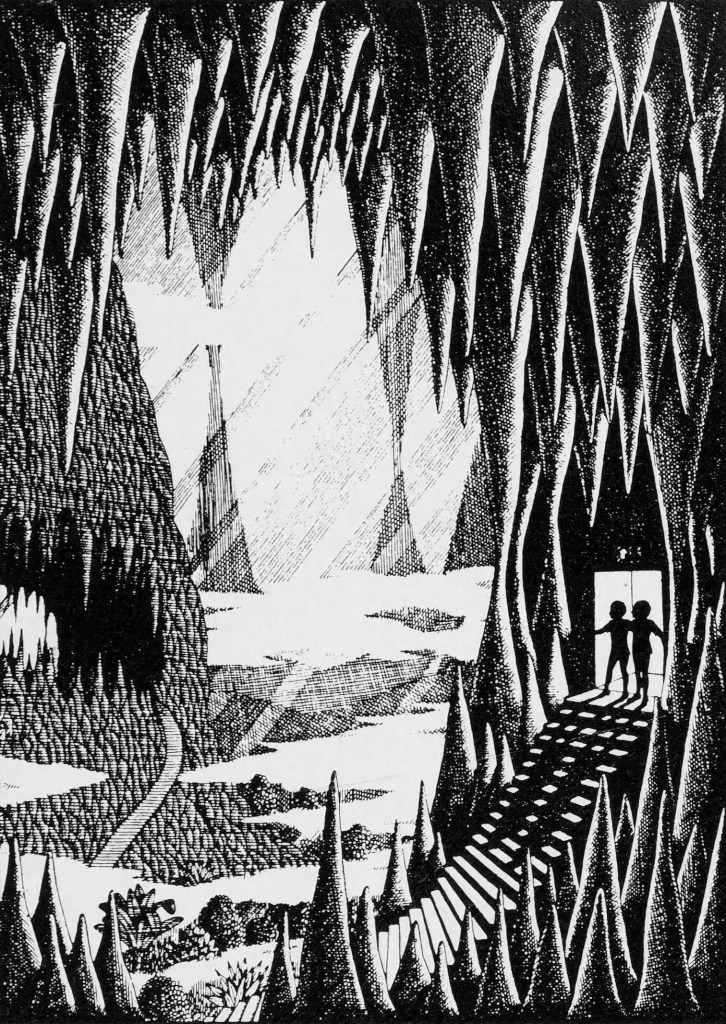
Dido fits the mold precisely. He’s at once manipulator and protector. He arrives suddenly, naked, carrying a light, and guides Barry through a submerged tunnel to a room on a craft reminiscent of both the enchanted fairy circles where music plays, and of illogical UFO interiors.
Lumen
A parallel can be found in popular science writer Camille Flammarion’s early science fiction novel Lumen (1872). In it, the spirit of a recently deceased man named Lumen engages in philosophical dialogue with a man named Quaerens. Liberated from the constraints of the body, Lumen now exists in space with enhanced perception. His relationship with Quaerens mirrors that of Dido and Barry: a superior being revealing metaphysical truths to a more limited companion.
Flammarion explored the gap between appearance and reality—a timeless philosophical conundrum harking back to Plato’s cave allegory. In Lumen, the limitations of human sensory perception are explored through the physics of light. He explains that what we see in the stars is a view of the past: “things are not what they appear to be.”21 Dido echoes this idea when he tells Barry “when you saw a star, you were seeing how it looked hundreds or thousands of years ago.”22 Lumen goes further, explaining that there are countless inhabited worlds interconnected across space, and a disturbance in one resonates through the others: “like that of a musical cord which vibrates.”23 An analogue of this is the “telephone exchange”24 of psychic communication that Egonians spend decades training for. Developing their exceptional abilities they telepathically communicate across space with billions of other worlds, and can remotely operate spacecraft.
Human senses detect only a narrow band of information from particular moment in time, but freed from the body, Lumen gains access to the full spectrum—allowing him to playback historical events, even from his own life:
This child was really myself, flesh and bones. It was no mirage, no vision, no spectre, no reminiscence, no image; it was reality, positively myself, my thought and my body. I was there before my eyes.25
Barry’s experience in the Timeless Caverns—one of the many wonders shown to him by Dido—is similar. There he has visions of other worlds, of all history, and of his own life, and he’s astonished: “I saw myself being born. I saw myself as a baby. I saw everything I’d ever done.”26
Both books share the idea of light as a medium of eternal memory. Dido tells Barry, “Space is filled with light from all time”27 Egonians use what is called “light science” to tap into this ancient resource, to illuminate the sea, and to project images and memories with their advanced receiver technology.
This parallels Flammarion’s writing:
the past life of all worlds, and of all beings, is always visible in space, thanks to the successive transmission of light across and through the vast regions of the infinite.28
For both authors, light is a carrier of history, and all moments remain accessible—if one knows how to retrieve them.
Faster Than Light
Lumen also explains how thought travels faster than light. He recounts how he reached the star Capella—72 light years from Earth—instantaneously by projecting his consciousness. Similarly, Egonians don’t use light to communicate across the vast distances of space. Instead they use thought, which lays outside of the electromagnetic spectrum:
If you radioed a message to a planet three hundred light years away, it would take three hundred years. But if you did it on thought, the message got through immediately.29
In another parallel both guides doubt their students’ capacity to comprehend. Lumen tells Quaerens: “The real nature of things entirely escapes your understanding, and you are utterly incapable of comprehending the universe.”30 Before his change of heart, Dido mocks Barry’s intellect, comparing him to a dog—and even an ant.
Again, these similarities would be lost on the original audience for Under Plum Lake yet identifying them allows us to see how the guide figure functions in Barry’s journey.
Odd John a Template for Dido
The gulf in abilities between the guide and neophyte leads to another literary comparison. Dido, the 99 year old boy who first appears naked, has green eyes, white hair, casual Olympian abilities, and telepathic powers shares these characteristics with the title character of Olaf Stapledon’s Odd John (1936).
Stapledon—a fellow author from the North of England—created a formidable character in his exploration of the consequences if a new race of “homo superior” suddenly coexisted with humanity. John is a highly unusual child born to normal parents, he “mostly went naked” had “immense pupils” with “oddly green irises” and hair of “dazzling whiteness.”31 His stunted growth makes him appear younger than his actual age, yet he displays athletic prowess and agility, and intellectual prodigiousness—and like Dido, he is telepathic and exerts mesmeric influence on others.

However, Stapledon’s creation is far darker. John is a monster, he murders, curses humanity as stinking cattle, and seeks isolation to form a colony of similarly advanced transhuman beings recruited from around the world. Like Dido and the “specialists” in Egonia this new race use psychic abilities to confuse the minds of any one who comes too close; “oblivifacation” obliterates the memories of any who might reveal their secrets.
In many ways Under Plum Lake is a more positive alternative conception of Stapledon’s dark tale about how a breakaway group and the current world might interact—how an upgraded race of humans might interface with one soon to be obsolete. Lacking a comparable subterranean haven, the Odd John and the “homo superiors,” as they are called, must establish themselves on the same physical plane. They choose a remote island whose native population they brutally wipe out. They are an “island of monsters”32 and use their telepathic powers to develop “astronomical consciousness” connecting with the “myriads of peopled worlds”33 across space. Ultimately, the tensions between the two worlds are too great, and the colony ends in disaster and self-destruction.
In Davidson’s version there is at least stability in the order of things, even though we learn the surface world is inferior.
Clues to Hollow Earth Literature
The imaginative world of Under Plum Lake also unmistakably references themes and repeated motifs found throughout Hollow Earth literature. Exploring the notion that below the “skin of the apple” of Earth’s crust there exists habitable spaces has been the topic of numerous fantasy stories and what’s interesting is which elements Davidson chooses to add to his version.
An early example is Laura: A Journey into the Crystal by George Sand (1864). It imagines the Earth as a giant geode where our mountains “form no more than relative projections which the bumps on an orange skin present in relation to the size of a pumpkin”34 and where a similar texture is found on the other hollow side of Earth’s crust. Access to this “colossal interior world” is to be found at the poles. Like Barry’s journey into Egonia, Sand’s story is told by one person with no other witnesses, leaving the possibility that the adventure was a dream or hallucination.
In one of the most influential Hollow Earth texts, Edward Bulwer Lytton’s The Coming Race (1871), an unnamed protagonist enters a mine shaft and discovers a subterranean world—illuminated, technologically advanced, and populated by a superior race known as the Vril-ya. Like Davidson’s Egonians, the Vril-ya live in a utopia hidden deep beneath Earth’s surface. It is so deep that it also has its own sky and the inhabitants also possess flying machines, “air-boats” powered by a mysterious energy known as Vril. They wear mechanical wings that allow them to fly—details echoed by the magnetic cars and “power kites” in Under Plum Lake.
Zee, a female Vril-ya who becomes the narrator’s guide, calms his anxiety, relieves his pain, or induces sleep by touching him on the forehead, Bulwer Lytton wrote: “Zee quietly pointed her forefinger at my forehead and sent me to sleep.”35 Dido repeatedly does the same to Barry: “Good night,” he said, and touched my forehead and I was asleep again.”36
The society of Davidson’s Egonia mirrors of that described in The Coming Race, but is stripped of virtually all political subtext. Both underground civilizations are antediluvian, telepathic, and technologically superior. Both were formed in the aftermath of cataclysm. Both feature utopias so stable that ambition and conflict have disappeared—prompting some readers to find them dull.
The Coming Race is a satirical work exploring ideas about what a utopia on Earth might look like, about technological progress, and gender roles (it was later appropriated and twisted by writers who linked it to Nazi ideology, promoting ideas of superior races and Aryanism). Davidson, who was Jewish and spent a decade living in Israel, seemed content to borrow liberally from this setup, but mostly avoided discussions of race, or gender, (perhaps deliberately choosing to focus on the core science fiction idea of coexisting intelligent life) and Under Plum Lake has virtually no discussion of individual differences. The closest it comes to describing ethnicity is in a description of very ancient humans living on Earth’s supercontinent: “There were no black men or yellow men or white men; all were brown and of the same build and appearance.”37 He later writes that Egonians like Dido had green eyes and white hair and skin only because they received filtered sunlight indirectly. And, there is only a hint of political idealism; for example, when Barry is told that surface people like him spend too much of their short lives: “swapping things with others, and trying to get the best of a bargain, and then fighting if they got the worst of it.”38
In each story the narrator must leave, unable to stay, and the parting echoes across the stories. Zee says:
Farewell forever. Thou wilt not let me go into thy world—thou canst never return to mine…When I reach the life that lies beyond this speck in time, I shall look round for thee.39
While Barry pleads:
Dido, you can’t leave me like this…I’m not in my time, and I’m not in yours.40
Another clear influence is Willis George Emerson’s The Smoky God; or, A Voyage to the Inner World (1908), a supposed true account of Olaf Jansen, a Norwegian sailor, who discovers a hidden civilization some 300 miles below Earth’s surface via a polar opening. The world he enters, called Eden, is illuminated by an internal sun41—nicknamed the Smoky God. Davidson borrows kind-hearted giants from Emerson’s story. Eden is populated by graceful beings who live for centuries, dress simply in “tunics of silk and satin and belted at the waist.” They also live far longer than people do on the surface, 600 to 900 years, which allows them to delay commitments, such as marriage, until they are 75 or 100 years old.
A constant theme in hollow earth utopias is their possession of advanced technology. Eden is no different. Their vehicles, “some electrical contrivance,” are anti-gravity machines that operate “noiseless fly-wheels” and travel around the subterranean world at high speed.
Another story Davidson may have read is The Moon Pool, (1919) by Abraham Merritt. It offers descriptions of both submerged Atlantis-like continents and an ancient intelligent civilization—the Murians—populating “vast subterranean spaces…beneath the ocean floor.”42 This space is accessed via the moon pool, a mystical portal discovered in ancient ruins on an island in the Pacific. This is clearly comparable with the sea cliffs and submerged tunnel illuminated by Dido’s light that is the portal to Egonia.
Again, there is hidden advanced technology, vehicles reminiscent of both Dido’s canoe and of UFOs, described as “fairy shells,”43 operated by levers, powered by an unknown power that moves them smoothly and silently. As in Under Plum Lake there is ancient intelligent life deep within the Earth; the “Silent Ones” who have patiently observed life on the surface as mountains rise and fall over eons. Yet, The Moon Pool (itself an inspiration for H. P. Lovecraft’s horror writing) is darker than Under Plum Lake, with a sinister being named “The Shining One” presenting itself as a beautiful luminous being which—like Dido—uses telepathy and mesmeric powers to overwhelm and capture people from the surface.
The Transmission of Hollow Earth Ideas
These Hollow Earth narratives—like alien abduction reports—share a structure and many common elements. They emerged out of errors in scientific calculations such as Newton’s 1687 overestimation of the mass of the moon,44 that influenced theories about why there is a variance of Earth’s magnetic field. A few years later Edmund Halley witnessed the aurora borealis and thought it might be caused by light escaping from below the surface. He theorized that Earth could be:
concave with a lesser globe included, in order to make that inner Globe capable of being inhabited, there might not improbably be contained some luminous Medium between the Balls, so as to make a perpetual Day below.45

Davidson captures this notion of a luminous medium trapped between internal spheres when Barry describes there being no ordinary light (sunlight) in Egonia, yet everything, all the roads and buildings glowed. Under the sea fish swim in a strange translucent medium the colour of “pale honey,” which is lit up for miles all around them.
In turn Newton and Halley’s errors influenced those with a frontier spirit, such as US army officer John Cleves Symmes Jr., who was seduced by the idea of discovering these habitable concentric spheres within, and who lobbied the US Congress in 1822, to fund an expedition to what he believed were polar openings leading to a hollow Earth.46
Hollow Earth stories were also given a spiritual dimension by legends about hidden kingdoms of Agharta or Shambhala, (Jacolliot 1873) and (Saint-Yves d’Alveydre, 1886). For example in Beasts, Men and Gods (1922), the occultist fantasy by explorer Ferdinand Ossendowski, recounts the legend of Agharti47—another subterranean kingdom—with a cave entrance somewhere in Central Asia. Ossendowski links it to Buddhist traditions, but his description proposes that it is more than a spiritual realm, or a metaphor; rather, it is an actual physical place hidden within the earth, he writes: “In underground caves there exists a peculiar light which affords growth to the grains and vegetables and long life without disease to the people.” Which is itself a reference to the “thrifty vegetables”48 growing inside Earth’s concentric spheres, the reality of which Symmes pledged his life in support of the truth of.
Once again there is a description of exotic vehicle technology: “In cars strange and unknown to us they rush through the narrow cleavages inside our planet.” And, the citizens, Ossendowski writes, “have reached the highest knowledge.”49
Again, these details are echoed in Under Plum Lake. Dido and his peers also travel in magnetic flying craft and speak all the world’s languages.
Agharti is described as “The Mystery of Mysteries”—a repository for ancient wisdom and concealed truth. Davidson would almost certainly be familiar with this folklore—especially given his 1962 novel The Rose of Tibet, which he wrote entirely from research. It seems likely Under Plum Lake emerged from that research, with Egonia as an analogue of Agharta.
As we saw in The Coming Race, these hidden people have mastery of all sciences and are also able to induce behaviour in others by their touch. Ossendowski writes: “The highest Panditas place their hands on their eyes and at the base of the brain of younger ones and force them into a deep sleep.”50

The leader of Agharti is “The King of the World,” who lives in “Palaces of wonderful crystal” at the top of a subterranean mountain. He has the power to heal and even resurrect the dead. Likewise, Davidson makes Dido’s father, who lives in a palace with rooms “built of diamond, and of ruby,” the “president of Egonia” who “runs the world.”51 He’s able to observe Egonia by use of teleportation machines, the implication being that he rules with near omniscience, making decisions that affect all inhabitants of Earth, even Barry’s resurrection.
Secrecy and fragmented memory is another shared theme. Ossendowski writes of a visitor to Agharti returning to the surface with, “crumbs of the sacred learning preserved in his memory.” Similarly, when Barry is “erased,” Dido ensures that he returns with a fragment of intact memory. Dido tells Barry that many have been to Egonia, but their memories are wiped before morning—preventing them from betraying the real world’s secrets. We hear more about this secrecy when Ossendowski asks his source:
“How many persons have ever been to Agharti?”
“Very many,” answered the Lama, “but all these people have kept secret that which they saw there.”52
Later, we hear of a man punished for speaking about Agharti:
The Lamas cut out his tongue in order to prevent him from telling about the Mystery of Mysteries.53
Davidson’s Egonians also attempt to silence their visitor—although in a less gruesome way—not by removing his physical ability to speak but by excising his memories and his capacity to think, making it impossible for Barry to reveal their secrets—or so they thought.
As the Agharti myth goes, those returning to the surface and able to speak about it must have been given permission to do so. Given the supernatural nature of these subterranean masters and their ability to control others’ thoughts, the traveler who is able to retell their story must have been chosen.
These similarities between Davidson’s Egonia and Agharti provide the biggest clue that Barry’s encounter in Egonia does actually have a purpose. It was not the futile experience he believes it to be, and he’s not a forgotten abductee, but, like many claiming alien contact, he is a messenger of the masters.
Clues to Theories about Ancient Civilizations, Submerged Continents and Lost Knowledge
Davidson’s Dido tells us that our current civilization is just one of many to have existed:
mountain ranges had built up from the sea, and life and civilisations had formed on them; and dozens of times they’d worn down again and returned to the sea as dust.54
The “mess up,” which Dido describes, was caused by an attempt at planetary engineering. One of these civilizations was so energy hungry and so advanced they attempted to shift Earth toward a new star—an effort which failed causing a catastrophic change to Earth’s crust breaking it into separate continents. This was before it was realized that they didn’t even need energy from stars because some superior (yet undefined) energy source could be used.
Davidson appears to be again referencing the broad evolutionary epochs explored in Olaf Stapledon’s science fiction. In Last and First Men (1930) which brackets an epic speculative time scale of two billion years, Stapledon describes the cyclical rising and falling of human civilizations from the first, our current civilization, to the last. The timescales he imagines are so vast that life on Earth: “Again and again passed from savagery to world civilization and back to savagery,” with each new race to emerge being significantly different from the last. “Second man”, for example—a race to emerge two million years after our current humanity—would resemble Davidson’s Egonians, more physically robust, living much longer than current humans with more time to tackle scientific and philosophical problems.
In Stapledon’s Star Maker (1937) his narrator has an out of body experience (not unlike that in Flammarion’s Lumen) where he visits and inhabits other alien civilizations. On this extraordinary journey he describes one of the “Mad Worlds,” ones which have made contact with life on other planets and named so because of the audacity of their engineering. They build titanic rockets on their planet turning it into a spacecraft in order to direct it to the optimal proximity to a star.55
The trick that Davidson uses is to borrow Stapledon’s ideas and place them in the distant past of his narrative. All these extraordinary events and feats of technological mastery occurred in a past unknown and unimaginable to Barry and his surface dwelling civilization. It is only through his experience meeting Dido that we gain the smallest glimpse of this deeply hidden history.
The Shaver Mysteries and Readers Letters
An urban legend associated with the The Shaver Mysteries may have also influenced Davidson’s choices. Richard Sharpe Shaver’s stories—themselves inspired by Merritt’s The Moon Pool—were edited and promoted by Ray Palmer in Amazing Stories, beginning with I Remember Lemuria in March, 1945. They brought a huge new audience to the idea that Earth was once home to advanced beings. In the world Shaver created, these beings called Titans or Atlans, were giants who were forced to escape Earth but who left behind a legacy of artefacts and lesser beings—called “Abandondero”. But, unlike the earlier hollow earth stories mentioned above, some of these subterranean dwellers—the “Deros” short for “detrimental robots”—were malevolent, and interfered with people on the surface, abducting some of them for experimentation, causing accidents, and even starting wars.
Shaver claimed to have had real personal experience with these ancient immortal beings, having entered the caverns of the inner earth via a smugglers cave—curiously also the entry point to the underworld in Under Plum Lake—and he maintained that his writing was the product of his reassembled memories and readings from “rock books,” which was the deciphering of hidden knowledge encoded in the striations in cut rocks—a belief widely dismissed as pareidolia.
It was this blurred line between fact and fiction that contributed to a compelling urban legend associated with Shaver’s writing; that hundreds, if not thousands, of readers of his were compelled to write letters to Amazing Stories claiming to have had similar experiences of underground contact.
I Have Been In The Caves
While the number of actual letters received is disputed, among them one stands out. Margaret Rogers’ letter published in Amazing Stories in January 1947, titled I have been in the Caves. Her story shares numerous uncanny parallels with Under Plum Lake and is worth looking at in detail.

Rogers described being a destitute heroin addict before meeting a Dr. Kellner from the mysteriously titled “Electro-Therapy Institute,” a man with hypnotic grey eyes who promises to cure her addiction. Strange things begin to happen to her and she has the feeling she is being watched and that the events around her are somehow being orchestrated—just as Barry feels an unseen presence guiding his exploration of the sea caves.
When it looks like she’s about to be arrested for drug possession Margaret finds herself spontaneously uttering nonsensical words, a strange incantation that miraculously causes the narcotic agents to ignore her, allowing her to flee the scene. Later she is guided by Dr. Kellner to a concealed cave entrance. Inside, the dark cavern fills with a strange blue light, and she feels compelled to continue—mirroring Barry’s feeling “full of strange knowledge”56 and his compulsion to continue on into the cave against his will.
Margaret’s description becomes dreamlike. She’s submerged in “cool green waters”57 sees a soft lavender light, and awakens naked, laying on a silvery metal table in a great room surrounded by towering figures. Barry, similarly, disrobes before entering the glowing tunnel illuminated by Dido’s green light and emerges from the cold water to a similar place of comfort, Dido’s “canoe” with its carpeted floor, sofas, and softly playing music.
Margaret is given a beautiful robe and soft sandals to wear; Barry is given a one-piece tunic and long tights. Both are offered restorative drinks. For Margaret it’s “a sweet drink made of fruit,” like “nectar of the Gods.”58 Barry is given “Tigra”, a silvery liquid made from the nuts of Egonia’s strange trees that makes him feel “marvellous” and “wonderful.”59 Later, Margaret is given a metal container brimming with a pale green foamy liquid named Pachi. She drinks from it and puts it down and to her amazement it becomes full again. Barry is given giant plum-like fruits called Ragusa that are also self-replenishing: “as you chew it the part you’ve eaten grows back in place.”60
Margaret finds herself in a metallic room, where “furniture and walls alike all seemed to be made of silvery metal.”61 Barry notes that “The walls, the floor, the ceiling were of metal, but not of metal I’d ever seen. It shone softly, a bluish green.”62 Rogers is transported in a vehicle that has “no motor, no wheels,” that reminded her of a “torpedo with two seats.”63 It is controlled by thought alone. Barry, too, rides in a wheel-less car that operates silently.
In contrast to Shaver’s dark vision of demonic creatures living inside the Earth, Margaret describes meeting giants—the Nephli—who she insists are benevolent beings, more akin to what Shaver named the Tero. These “godly people who do not kill”64 avoided conflict with surface dwellers and chose to live underground.
The Nephli civilization is like that of other Hollow Earth narratives but it also anticipates Davidson’s Egonians. Both were highly advanced when they abandoned Earth’s surface. Both civilizations are age defying. Rogers meets Arsi, a giant who claims to be over sixty years old but to her looks no more than twenty-five. Barry meets Dido, who appears to be a boy his age who is already nearly a century old.
Mira (Meera) Dido (Deedo)
Margaret’s guide and mentor in the underworld is a giant woman named Mira. Given the other similarities between the stories, it seems odd for it to be only a coincidence that Rogers specifies the pronunciation of “Mira” as “Meera.” In exactly the same way Davidson asks us to read “Dido” as “Deedo.” The fact that Davidson makes this distinction is one of the mysteries of Under Plum Lake because it is never explained why the name should be heard in that way. If the aim was to give Barry’s guide a strange alien-sounding name, why not simply write it as “Deedo” throughout? What purpose does including this pronunciation guide—emphasising the long vowel sound shifting from the short “i” to a long “ee”—have?
Perhaps, by keeping the spelling “Dido”, Davidson wanted to maintain some symbolic connection with that other famous companion, Queen Dido of Carthage in Virgil’s Aeneid? The Queen, devastated at the hero Aeneas leaving her, killed herself. Then when in the underworld she refused to speak with Aeneas, which is somewhat similar to the conclusion of Under Plum Lake, where Dido (who Loves Barry) remains silent despite Barry’s pleas—however, the analogy seems imperfect.
Then again, perhaps this is another example of Davidson’s “being a bit tricky,” a deliberate and subtle reference to classical literature and to Rogers’ obscure letter to the editors of a science fiction pulp from the 1940s, both of which offer a hint to the more adult themes in his children’s book.65
Like with Stapledon’s Odd John, Margaret’s story offers us a glimpse of alternative endings for Under Plum Lake and what the experience means for Barry Gordon. At the end of her story she is sent back cured of her heroin addiction. Before she is returned to the surface, her memory is manipulated, just as Barry’s is. At one point she sees another man healed and returned to the surface; her guide explains: “All memory of his accidental fall into the cave and his experiences while here are erased from his mind”66 Again, this is reminiscent of other Hollow Earth narratives and mirrors the fate of those who return from Agharta, and it is also a core aspect of alien abduction. Margaret, has limits placed on what she can say—but unlike others, she is told she has been chosen and that her full memory will eventually return. She is promised: “You…will remember everything. You will say nothing until the time is ripe. Then you will tell just what we tell you to say.”67
Barry, by contrast, is given no such assurance. There is no promise of future clarity. He is left disoriented and emotionally fragmented, with no clear understanding of why he was taken. Rogers, by comparison, learns that she is part of a secret program linked to her Nephli bloodline. Once cleaned up, her mission is to return to the surface to find others like her—those who “…eventually remember or…will dream, and in dreams be shown their heritage.”68
When Margaret is returned, she is assured of protection: “we will guard you. Nothing can happen to you, of ill.”69 Dido, too, makes a similar vow to Barry: “I’ll see no accident happens. I’ll try as hard as I can. I’ll always watch you, Barry. I’ll be your good angel.”70
Rogers is also told that, in time, she will “say the word”—another involuntary incantation—that will trigger her return to the Nephli. In twenty years, she is told, she will go back to the underworld, where the Nephli, armed with advanced science, will rise and bring peace to the surface world.
(Coincidentally this prophecy is echoed in Ossendowski’s Beasts, Men and Gods, which according to some interpretations, forecasts that in the year 2029, the 800 million inhabitants of Agharta will rise up from their subterranean realm).
Readers of Under Plum Lake are left without certainty about what comes next. Barry believes his experience is unique—but is it? Perhaps, like in Margaret’s story, there are others who share a similar connection with Egonia? Will his meditative visits to the cave eventually trigger a return or will he one day find himself able to remember clearly everything that happened to him? Davidson offers no answers, and the book ends abruptly, with no indication of a sequel. The ambiguity is the final mystery. However, by looking at texts like Margaret’s letter which contain so many similarities we—as with Odd John—at least have a template for speculation about what those answers might look like.
Clues to Shamanic Initiation
There is another interpretive framework that deepens our understanding of Under Plum Lake: the practices of shamanic initiation.
Barry, like Margaret Rogers, or even like the boy Matthew, in John Wyndham’s Chocky, is chosen, singled out for contact with superior non-human intelligence. His journey follows the patterns seen in Shamanic initiation described across numerous cultures, as detailed in the work of Mircea Eliade—the similarities are unmistakable.
As Eliade noted in North American shaman legends: “Caves play an important part in the initiation…it is in caves that aspirants have their dreams and meet their helping spirits.”71 The shaman is “the one who knows,” who “succeeds in having mystical experiences,” whether “chosen or called by Superhuman Beings.” A “Shaman is, therefore, the [one] who can die, and then return to life.”72
Barry’s narrative conforms to this template. He enters a cave and descends with his guide Dido into a hidden world. He undergoes a series of tests: his comprehension is stretched by cosmological revelations; his ego is confronted by the three-dimensional projection of himself beside himself; his sense of singular personhood is dissolved in the ecstatic mystical experiences at the Pleasure Dromes, and the Holy light seen in The Abyss. Finally, there is a physical test on the “power kites,” which he fatally fails—or succeeds in depending on interpretation.
Dido is beside him when he watches his own brain being separated from his body. Barry has an out-of-body-experience while his body is repaired after the kiting accident, echoing shamanic legends in which the candidate’s head is removed and set aside, in order for them to witness their own dismemberment and reconfiguration.73
But unlike a shaman’s initiation, Barry’s journey is not explicitly announced or recognised as such. He is returned to his normal life with no support or awareness of what he has become. He is left to flounder in confusion, not yet realizing that he is the shamanic candidate, that he knows. The special power bestowed upon him is the ability to write his journal—something that no one else has previously had the power to do—to document the ineffable. Under Plum Lake, the narrative itself, is a testament of Barry’s initiation.
Clues to Alien Abduction Investigations
Alien abduction researchers often relied on hypnotic regression to access memories blocked by supposed forced amnesia. This controversial technique is believed to place the subject in an altered state,74 allowing them to relive forgotten events, often from a detached third-person perspective. It is believed subjects could playback the events like the scrolling back and forth of a video recording. What convinced many researchers was the intensity of emotion expressed during this “revivification,” that was taken as proof that the memory corresponded to real events.75
Proponents of the practice saw the results of studies such as the Stalnaker-Riddle76 experiment from the 1930s as proof of hypnosis’ efficacy in recovering memory. This was an experiment that tested a subjects’ ability to recall words of verse or prose in a hypnotic state and normal waking state. It appeared to show that the hypnotic state gave 53.7% better results than the waking state. However, other researchers found the results difficult to replicate bringing into question the methodology of the original test.
Over the years, other experiments showed that hypnotic suggestions to remember provided no advantage over those given during a normal waking state. While hypnosis increased productivity—people under hypnosis talk more—and so have a higher chance of recalling correct information when tested. It also increased the chance of recalling confabulated, incorrect information and of being falsely confident in the veracity of those recollections.77
As a result of experiments to test whether hypnosis produced accurate memories of forgotten things, experts concluded that this kind of forensic hypnosis was unreliable because neither the subject nor the hypnotist could decide which expressions of memories were true without independent corroboration.78 This was a real problem for alien abduction researchers because independently corroborated abductions are extremely elusive. To make things even more confusing, measuring how saturated subjects were by a media culture obsessed with science fiction and depictions of aliens and UFOs is difficult. Researchers often relied on subjects self-reporting their awareness of these contaminating cultural images, with subjects who might begin to retell their experience with comments like “I’ve never been interested in UFOs…but.”
Betty Andreasson
A notable alien abduction case retold with the aid of hypnotic regression is that of Betty Andreasson. As we saw with Margeret Rogers’ narrative Under Plum Lake, has some remarkable similarities with Andreasson’s story. It allegedly occurred on January 25, 1967, although she did not report it until many years later 1974, in response to a National Enquirer call for alien abduction stories.79 Her case was chronicled in The Andreasson Affair: the true story of a close encounter of the fourth kind by Raymond Fowler (1979), published just a year before Under Plum Lake. It is mostly formed of transcripts from Betty’s hypnotic regression sessions in which she described an encounter with small humanoid beings who entered her home then took her aboard a strange craft.
Andreasson’s case stands out because of the rich detail she gave while under hypnosis, and for her ability as an amateur artist to render concrete visualizations of her experience. Her account begins with lights in her backyard and figures who pass directly through the solid wood door of her kitchen. Betty meets a being with an odd name, Quazgaa, who, like Dido, communicates telepathically. She’s taken aboard a craft, travels to a beautiful colourful realm, and meets a green-eyed woman in white.80
Andreasson described how the beings she met were already familiar with her. They already know Betty’s name when she first meets them. It is as if she was chosen, and they had been watching her her whole life.81 Similarly, Barry sensed he was being observed when exploring the sea cliffs. He is called by name when Dido first greets him. Both are compelled to follow their guides.
Quazgaa reassures Betty by making the hull of the craft transparent82 allowing her to see its internal mechanisms. Dido performs a similar trick, making the hull of the “canoe” transparent allowing Barry to marvel at an illuminated undersea canyon and swarms of multicoloured fish surrounding them.

In the details of Betty’s abduction we again see familiar tropes from Hollow Earth literature that are echoed in Davidson’s story. She is asked to remove her clothes and change into a loose fitting white garment. Similarly, Barry removes his clothes before swimming through the tunnel in the sea cave and upon surfacing and entering the canoe is given a tunic and tights to wear.

Note the similarity to the illustration above
Betty is taken on a voyage in a craft—a UFO. She reports being able to look down on the marvellous sights, such as a city of crystal, a pyramid, domes, and an “emerald green”83 sea with colourful fish—another scene replicated by Davidson.
Betty is given a strange sweet tasting liquid “like cough syrup” that she says makes her feel good, and relaxed. Likewise Barry is given Tigra which “coats [his] stomach silver and acts on [his] brain.”84 Betty is dried by warm air after emerging from a liquid-filled chair; Barry stands on a grid that instantly dries him after emerging from the tunnel.
Betty is examined and feels pain from needles inserted into her nose and abdomen, but the beings remove her pain using a now familiar method; touching her on the forehead: “they put their hand on my forehead and on the top of my head, and it took some of the pain away.”85 Barry also undergoes an examination. A touch on the forehead from Dido is used to gain or give him information or put him to sleep, but he is also poked, prodded, and physically passed around by his captors. His body is reassembled after the crash, and he’s laid on a table in a large room while the specialists perform a procedure to erase his memories.
Betty’s encounter ends with her safe return and selective amnesia—as does Barry’s.
The Andreasson Affair coincidentally includes allusions to hollow earth-like narratives. Betty is unsure whether she was taken into space or deep within the Earth. “I believe we were in space, and somehow I believe we were in the center of the earth.”86 She continues, “Not on top of this earth. I could have been inside the earth, but I went someplace else other than the earth.”87 She also refers to a tunnel “like a coal tunnel”88 Fowler editorializes “It reminded her of some legendary underground kingdom,”89 which is suggestive of the Agharta mythos. Betty says some visitors “come from realms where you cannot see their hiding place. Some come from the very earth” adding “There is a place on this very earth that you do not know of.”90
Like Dido, Quazgaa uses his eyes to transmit thoughts. When he bids Betty farewell, he locks eyes with her and says she must forget her experience for now but promises: “They will be revealed when the time is right”91 (again a familiar promise also found in Margaret Roger’s story). Dido similarly modifies Barry’s memory with an intense gaze: “My eyes seemed locked on his. There was a strange flicker in the green eyes, and a prickling sensation in my head.”92
Finally, Betty is told that love is the answer. Barry is told that life is a game and “fun”. But, unlike Betty who has researchers documenting her experience, Barry’s story ends without adequate interpretation. His thoughts and transformation are left for the reader to decode.
Why Me?
When Under Plum Lake was published in 1980, alien abduction narratives had not yet reached cultural saturation. Spielberg’s Close Encounters of the Third Kind (1977) introduced the “little grey alien” to a mainstream audience, but it wasn’t until later when Budd Hopkins’ Missing Time (1981) and Intruders (1987) that the abduction phenomenon was codified with the familiar elements: time-lapse, selective amnesia, bizarre interior spaces, and other recurring motifs across multiple cases. Whitley Strieber’s Communion (1987) and the subsequent 1989 film starring Christopher Walken further solidified alien abduction in the mainstream imaginary, while the 1992 television miniseries Intruders, based on Hopkins’ book, provided an horrific visualization that completed the transition away from alien contact being with beautiful benevolent beings, like the ascended masters of occult texts, to the notion that aliens were ugly and malevolent. Harvard professor Dr. John Mack’s high-profile endorsement in the early ’90s, via his interviews with abductees and subsequent media appearances, cemented abduction as a major subject in both psychology and pop culture.
Yet, Davidson anticipated the popularity of this phenomenon, and its themes and ideas in granular detail almost a decade earlier. Somehow he selected the most resonant motifs—watchful alien observers, underground realms, UFO technology, memory loss, and enforced secrecy—and wove them into a seemingly ambiguous children’s story, while freeing them from the more sensational or political elements.
Under Plum Lake asks the most enduring question of all anomalous experiencers: Why me?
Unlike real-world abductees, Barry receives no therapeutic help—he fears the day “the doctors would prove I was crazy”93 and is afraid to share his fragmented memories with anyone, but the echoes with alien abduction are unmistakable. The Egonians are not humans. They are beings of a different species from “inner space,” who effortlessly abduct surface dwellers for sport and return them to their beds before morning.
Dr. John Mack would not coin the term “ontological shock” as it relates to alien abductions, until a decade after Under Plum Lake, but Barry Gordon already embodied it. His fragmented recollections, vivid dreams and flashbacks, and his struggle to comprehend what had happened reflect precisely what later abductees would report.
“Dreams are dreams, and reality is reality”
Barry Gordon is certain his experience was not a dream, he writes: “I felt I hadn’t dreamed. I felt I’d remembered. I felt it had happened. Could it have happened?” Real-life abductees often begin exploring their experiences in the same way—through recording and analyzing their dreams.
Hopkins, in Missing Time, asserted that “sometimes dreams contained suggestions and even partial details of forgotten abduction experiences”94 Edith Fiore, in Encounters (1990), described investigating a “remembered a fragment of a dream” that was “vague and fuzzy”95 but, she believed, it was her real experience of being shown around a room inside a UFO. David Jacobs went further in Secret Life (1992), claiming he could distinguish false dream memories described by his subjects from authentic alien encounters. He wrote: “memories or dreams can become an obsession as the unaware abductee desperately tries to understand their meaning.”96 Finally, Mack, in Abduction (1994) provided the practice academic authority, writing: “After the abduction the experiencer may have varying degrees of recollection of what occurred. Sometimes what happened will be remembered as a dream.”
As dramatized in The UFO Incident (1975), James Earl Jones, playing Barney Hill, while still skeptical about his supposed alien abduction insists, “Dreams are dreams, and reality is reality.” Barry’s experience, however, blurs that boundary completely. Barry has the dreams but they contain indissoluble fragments of reality. Davidson also provides him with physical proof that something real and unexplained had happened to him.
Barry’s Evidence
This evidence anticipates that claimed in later abduction literature. For example in Abduction (1994), Mack writes:
The abductee may wake with unexplained cuts or other lesions… small lumps under the skin, a headache, or nosebleed. Generally experiencers are quite tired afterwards and feel as if they have been through some sort of stressful Experience.97
Mack could easily be describing Barry Gordon, who returns from Egonia dizzy, exhausted and “weak as a kitten.”98 He remembers flying dreams, but most strikingly, he bears physical evidence: a perfectly healed shoulder fracture fixed by Egonia’s doctors and unexplained by his doctor or parents.
Davidson writes:
He [the doctor] asked when I’d broken my shoulder. My mother said I’d never broken it. He was looking at an X-ray, and he said I had. He said it was a beautiful job of resetting, and so well healed that it must have been done years ago…99
This is detail is uncannily similar to a scene from the television mini series Intruders (1992), based on Hopkins’ abduction research, where an abductee is shocked by a conversation with her doctor:
Are you sure you’ve never had surgery? Because your X-rays show quite different… It’s extremely complex nasal surgery, performed on you several times, most recently in the past 6 months.100

Under Plum Lake may be many things—a parable, a philosophical tale—but it can also be read as the ventilation of a trauma. Instead of a therapist, Barry tells his story to us. The reader becomes hypnotized, able to scan back and forth through the book like a video recording, piecing together the clues that Barry himself has written but cannot yet fully understand. Seen through this lens our attention is drawn to certain phrases that Davidson repeated verbatim throughout the book. It’s as if he is telling us to pay attention to them saying “these are the clues, these things are real.” If we do, we may see Under Plum Lake also as a prediction.
Thousands of Readers Letters (again)
The Shaver Mysteries were not the only literary phenomenon to prompt a deluge of letters from readers claiming anomalous experiences. Budd Hopkins, following his publication of Missing Time (1981) received hundreds. After the release of Communion (1987), Whitley Strieber claims to have received tens of thousands from people who believed they had encountered his same “visitors.”
That such a response could be sparked by a book makes it plausible that a children’s novel like Under Plum Lake, framed around a common childhood experience of exploring sea caves and adventurously hunting the unexpected while on holiday, and with its multiple layers of familiar-sounding folklore, might have also triggered a deeply felt sympathetic response in those who read it.
“Jumbled Up in My Mind” — Alan Godfrey
One notable abduction case occurred just days after Under Plum Lake‘s release. In the early hours of November 29, 1980, police officer Alan Godfrey, driving near Todmorden, West Yorkshire, reported seeing a hovering dome-shaped object. He blacked out, then reawakened a short distance down the road. Almost a year later, he underwent multiple regression hypnosis sessions in which he described a classic abduction scenario: being taken aboard a craft, meeting a robed figure named Joseph, and being surrounded by small metallic humanoids. In a later television interview, Godfrey admitted:
After my initial sighting I did read quite a few science fiction books, and it is quite possible that that part of the hypnotic regression has got jumbled up in my mind.101
Given the timing and the regional UK press attention Under Plum Lake received it is entirely possible Godfrey had read it before his regression in 1981. What makes this compelling are the numerous details in his testimony that align with the book:
The feeling of being watched: Godfrey told his hypnotist that they were expecting him, “Joseph knows me” he says. In Under Plum Lake as Barry had also felt watched while he explored the sea caves and is greeted by name. Both felt a sense that events had been pre-arranged. (We should also remember that this sense of a curated experience was described by Margaret Rogers and felt by Betty Andreasson who were greeted by beings who already knew their names.
Telepathy: Godfrey reports: “I’m thinking what he’s saying… it’s in my head.”102 Likewise Barry says: “He just thought and I knew it”103 when Dido answers questions that Barry doesn’t even ask aloud. Again, telepathy is common trope of hollow Earth literature and is perhaps the most consistently reported phenomenon with close encounter events. It occurs in Andreasson’s case, but also many others. (It even arises in historical accounts like Emanuel Swedenborg’s 18th century visions of journeys to other planets; he described how knowledge from the beings he met: “fell into my inner comprehension…like a stream of highly rarefied air.”)104
An Imperative for secrecy: In Godfrey’s hypnotic regression, Joseph tells him: “You should not be seeing this [the UFO] this is not for your eyes.”105 Similarly, when Barry glimpses the shining Holy pillar in The Abyss, Dido insists: “You’ve got to forget this…You’re absolutely not supposed to see this!”106
Flashbacks and False Memories: Godfrey described having conflicting flashbacks and being unable to determine what was real. Likewise Barry is implanted with false memories and upon introspection struggles to distinguish dream from recollection.
Examination: Godfrey described being taken to “a ballroom, with a bed in it,”107 where beings surround him before some kind of examination. While Barry was taken to a palace to be “erased” where five looming “specialists” “bent over me and stared right in my eyes.”108 The setup—subject laying down surrounded by figures under an intense penetrating gaze—is classic abduction imagery.
Touch on the Forehead: Again a familiar detail from hollow Earth narratives. Barry feels pain when Dido touches him: “A kind of headache came and went, very fast.”109 In regression, Godfrey cries out: “there’s a pain in my head.” “I’ve got a pain.” “Where?” “In my head…It’s gone now.”110 Later: “He’s touching my forehead…with one of his hands.” “Yes – and?” the hypnotist asks. “Black” Godfrey replies, implying that the touch had caused him to lose consciousness.
A Carpeted Craft
But, the detail that most intrigued researcher and prolific author on the UFO topic Jenny Randles in her investigation of Godfrey’s experience was his mention of carpet inside the craft. “I have never heard of carpeted UFOs before”111 she said. So, it is notable that Davidson emphasized this particular detail three times, throughout his book, each time in exactly the same words:
…there was a room about thirty feet long. There was a carpet on the floor and a sofa all along one wall. There were easy chairs and a low table, and music was softly playing.
If Godfrey read Under Plum Lake before his hypnosis sessions (as seems plausible112) it is easy to imagine how this vivid detail might have stuck, “got jumbled up in [his] mind,” and shaped his expectations and interpretation of whatever event triggered his initial stopping in the road.
Full Circle: Shamanism and Abduction
The close association between Under Plum Lake and Shamanic Initiation113 brings us full circle back to the eight-part alien abduction structure identified by Bullard which he also considered similar to those patterns seen in shamanic initiation. His comparative study, and the majority of academic scrutiny of such reports, came years after Under Plum Lake was published, just before the epidemic of new abduction reports in the 1980s and through the 1990s. Yet, anyone familiar with the catalogue of reports predating Under Plum Lake will find it both eerily familiar and strangely fitting. It reads like a text-book abduction case, containing all eight of Bullard’s phases, appearing in much the same order, yet was published seven years earlier.
Dido, like the archetypal grey alien, effortlessly exerts total control over Barry. He summons him to the cave in the same way many abductees feel a sudden compulsion to take an unusual path or steer their vehicle down a darkened road. Dido uses his flickering green eyes to get inside Barry’s mind giving him new thoughts or desires—a behaviour only later given the name “mindscan” by abduction researcher David Jacobs. The “canoe” Dido navigates is a craft with capabilities indistinguishable from that of a UFO, sometimes becoming transparent allowing what’s outside to be seen and other times stretching its internal dimensions like the chrome-silver alien spacecraft later depicted in the 1986 film Flight of the Navigator.
Post Abduction Syndrome
Most significantly, Under Plum Lake, also includes the hallmark psychological features of abduction: the trauma of forced amnesia and not knowing whether your own thoughts are true or implanted false memories, and it conforms to another structured analysis—that of “post-abduction syndrome” (Westrum, 1986). This is a collection of post-traumatic stress disorder symptoms proposed by researchers to be specific to those living in the aftermath of alien abduction. It includes: a sense of neurotic hyper-vigilance, flashbacks and dreams about odd or unremembered events, distraction and a feeling of no longer being oneself, an unwillingness to discuss the triggering event. Barry’s vivid dreams and his attempts to analyse them, his obsessive returning to the cave each night to monitor the situation, and the sense of shame or reluctance to talk about his experience are perfect examples of these symptoms. These are the very things that abduction researchers would later explore and try to ameliorate using support groups and hypnotic regression therapy. That Davidson incorporated these elements into his work in 1980—before the structure of abduction was codified and before a breakdown of its symptoms was devised—suggests not only an unusual prescience but a remarkably intuitive grasp of an emerging phenomena.
If Barry is a shaman, he is also an abductee. And if Under Plum Lake is a children’s novel, it is also a visionary blueprint of human contact with aliens.
Conclusion: Reading Under Plum Lake in 2025
Lionel Davidson was a meticulous researcher and skillful writer. His mischievous layering of Under Plum Lake with clues alluding to philosophy, hollow earth and atlantis canon, occultism, shamanic initiation, and alien abduction reports, and the fact that he makes the story Barry’s alone, show his intention was to draw the reader’s attention to the question of anomalous experience and the impact such an experience might have on a young mind. If this was not the actual purpose of the book it’s certainly its effect.

We see the dual audiences addressed by the book because Davidson used his real name instead of David Line, the pseudonym he used for his other children’s books, and the way the book is written complements this. To a child with no understanding of the layered references Barry Gordon is a blank slate merely doing his best to describe events as they occurred. But a more knowledgeable audience can see he’s an empty vessel who has no choice but to go with the flow. He has no agency. Events just happen to him, and even the things he thinks he’s in control of—like sneaking out of his bedroom window at night—were pre-arranged for him. He’s a spectator and an abductee. Davidson shows us a glimpse of the real world through his eyes and asks us to imagine how we would react in similarly ontologically shocking circumstances.
But, Davidson also wants the reader to know that Barry Gordon’s experience was real, not an hallucination brought on by noxious fumes inhaled while exploring the caves, a dream—like Alice had of Wonderland—or a hypnagogic vision brought on by exhaustion. And, Dido is not an apparition, but as physically real as Barry is. Barry’s words are intended to be read as a memory, or a collage of memories approximating the full picture of his experience, not as a psychedelic fantasy, and the physical evidence of his expertly mended broken shoulder ensures we understand this.
As we’ve seen, Under Plum Lake seems filled with predictions: of the structure of alien abduction, and of the symptoms of its psychological impact. This foreshadowing quality has only matured as the ideas alluded to in the novel have gained greater cultural traction over the decades since it was published, becoming instantly recognisable memes in themselves. For example, Barry Gordon entered his rabbit hole twenty years before the now well-worn trope from The Matrix (1999), in which Morpheus offers Neo the red pill to see “how deep the rabbit hole goes” and to wake up to the real world, Zion the refuge of humanity hidden beneath Earth’s surface; and It came more than a decade before archaeological conspiracy theorists like Graham Hancock began capturing imaginations with the unproven claim of a lost ancient civilization possessing advanced technology. Under Plum Lake arguably surpasses these recent theories, drawing on Olaf Stapledon’s visionary imagination and breezily suggesting that our current human race is just one of many advanced civilizations to have lived on Earth—some of which mastered nuclear energy and spaceflight in antiquity. These civilizations have either vanished, left Earth, or concealed themselves within it.
The book also predates, by nearly a decade, the surge in alien abduction research, predicting the trend of dream analysis as a method of picking at a thread which might reveal a connection to memories obscured by forced amnesia.
Telepathy, remote viewing, astral projection, and other psychic abilities have also seen a surge of interest in recent years. It’s now easy to recognize the concept of the “light science” taught to the hyper-evolved Egonian brains, and of their training for a kind of precisely operated mental connection with machines and beings in distant space. Under Plum Lake also nods toward another recent trend of quantum mysticism and musings about Einstein’s “spooky action at a distance”—the idea of a manipulable connection independent of light speed, enabling instantaneous communication regardless of distance.
By situating its aliens here on Earth Under Plum Lake also seems to anticipate the decline of the extraterrestrial hypothesis in favor of other more esoteric explanations for UFO sightings. Today’s popularity of the UFO topic with its rebranded abbreviations like UAP for unidentified aerial (or anomalous) phenomena and NHI for non-human intelligence, replacing more conventional concepts of aliens and their UFO spacecraft, and recent televised congressional hearings have shown the conversation increasingly leaning into occult notions: that non-human intelligent life may coexist with us, hidden, possibly inside the Earth beneath the oceans.
As we’ve seen in the selection of literature described above these are ideas first suggested during the scientific revolution by astronomers and mathematicians; then given character in hollow Earth adventure stories and by science fiction writers, and later mused over by ufologists—who see in them a convenient side-stepping of the hard problem for extraterrestrial visitors of interstellar travel, because the visitors have been here all along114—are enduring and continuously transmitted and recycled throughout our culture. Just as military figures like John Cleves Symmes once believed the Earth was “hollow and habitable within,” today a retired U.S. Navy Rear Admiral asserts with equal confidence that alien bases exist beneath the ocean floor.115 Such ideas have not gone away.
In 2025, the blurb for Under Plum Lake—“There’s a world beneath this world, under the sea”—feels timeless. It could serve as the subtitle for a nonfiction title or a whistleblower’s account on the bestseller shelf at any airport bookstore.

A Prediction of Our Time
So, despite predictions in science fiction being overrated there is a lot that Davidson’s book gets right, which makes it an even more fascinating read today—but was its predictive quality only coincidental or even accidental?
Davidson is among the few authors who didn’t typically write science fiction, yet whose singular piece within the genre precisely captured and anticipated future trends and anxieties. The most notable comparison might be E.M. Forster, whose The Machine Stops (1909), predicted a human existence reliant on and isolated by technology—strikingly similar to today’s permanently online society. (Is there something about authors turning briefly to science fiction that allows them unique insight?)
In a way Davidson could be likened to alien abductees who claim to have no interest in science fiction, yet when relaying their experience relate strikingly similar themes and images to those already in existence. But, how does such convergence occur?
The mostly skeptical writer Hilary Evans, in Visions, Apparitions, and Alien Visitors (1984), grappled with this same question. If aliens aren’t real, why do unrelated people across the globe describe the same kinds of beings and experiences?
In his explanation Evans borrowed from Rupert Sheldrake’s hypothesis of “Formative Causation,” which proposes that once something has occurred, its pattern is retained in nature’s memory (whatever that means) making it more likely to happen again. According to Sheldrake, an unmeasurable “morphogenetic field” conveys this information, which can be detected by minds separated by time and distance. In this reading, Davidson’s mind was one such receiver, expressing those patterns as Under Plum Lake. Evans expands this, comparing it to Jung’s notion of the Collective Unconscious—a shared image bank from which storytellers make withdrawals. Philosopher Bertrand Méheust suggested a similar “common imaginary stream” that writers like Davidson might feed from. This would explain why so many similar details—being taken underground, exotic technology, wonderful lights, strange foods, mind control via eye contact, telepathic beings etc—arise repeatedly in both literature and real-life reports.
If these ideas circulate in some kind of collective reservoir of imagination, maybe Davidson didn’t consciously weave all those references together. Maybe the story wrote itself, with motifs just waiting to flow through the right conduit.
But this explanation, though intriguing, is unsatisfying. Why invoke an unmeasurable theory to explain an unmeasurable phenomenon? When there’s plenty of evidence to examine; Davidson’s experience as a writer, his love of adventure stories and fairytales, and his proven expertise in clue-filled crime fiction. All these suggest a more likely answer: that he simply knew exactly what he was doing and used literary tools and material available to convey a message that was exceptionally attuned to the emerging cultural phenomena of a yearning to discover lost civilizations or make contact with aliens.
With this in mind Under Plum Lake provides a counterexample to Sheldrake’s theory. Critics of regression hypnosis have argued that anything achieved under hypnosis can also be achieved in a waking state, and if source monitoring (being clear minded and accurate about where your own memories and experiences come from) is unreliable for the hypnotized, it’s just as unreliable for the rest of us. Which suggests that Davidson may not have tapped into a psychic wellspring. He might have just read a lot of books, paid attention, been empathetic and connected some dots in the right way at the right time.
Like E.M. Forster before him, Lionel Davidson’s combination of insight, imagination, and serendipity gave us something remarkable. Under Plum Lake is not just a mesmerizing and economically written children’s story. It is—I have argued—a bold and timeless reflection on anomalous experience still rich with mystery and relevance today.
Of course you all know what flying feels like, because everyone has dreamed about flying, and is seems so beautifully easy—only, you can never remember how you did it.
Five Children and It – Edith Nesbit (1905)
Copyright © 2025 Gideon Reid
Bibliography
Bernstein, Morey. 1989. The Search for Bridey Murphy. New ed. Doubleday.
Bradshaw, William Richard. 1892. The Goddess of Atvatabar: Being the History of the Discovery of the Interior World, and Conquest of Atvatabar. J. F. Douthitt.
Bullard, Thomas E. 1987a. ‘UFO Abductions: The Measure of a Mystery. Volume 1: Comparative Study of Abduction Reports.’ The Fund for UFO Research.
Bullard, Thomas E. 1987b. ‘UFO Abductions: The Measure of a Mystery. Volume 2: Catalogue of Cases.’ Fund for UFO Research.
Bullard, Thomas E. 1989. ‘UFO Abduction Reports: The Supernatural Kidnap Narrative Returns in Technological Guise’. The Journal of American Folklore 102 (404): 147–70. JSTOR. https://doi.org/10.2307/540677.
Bulwer Lytton, Edward. (1871) 1972. Vril: The Power of The Coming Race. Rudolf Steiner Publications.
Clifford Birchall. 1980. ‘The Mysteries of Plum Lake…’ The Ormskirk Advertiser (Lancashire, England), October 2. https://www.newspapers.com/article/the-ormskirk-advertiser-etc/154701645/.
Davidson, Lionel. (1980) 1983. Under Plum Lake. Bantam Books.
Eliade, Mircea. 1958. Rites and Symbols of Initiation: The Mysteries of Birth and Rebirth. Harper & Row.
Eliade, Mircea. 2004. Shamanism: Archaic Techniques of Ecstasy. Bollingen Series 76. Princeton University Press.
Emerson, Willis George. 1908. The Smoky God; Or, A Voyage to the Inner World By. http://www.gutenberg.org/ebooks/3007.
Evans, Hilary. 1984. Visions, Apparitions, Alien Visitors. Book Club Associates, Thorsons Publishing Group Ltd.
Fiore, Edith. 1990. Encounters: A Psychologist Reveals Case Studies of Abductions by Extraterrestrials. 1st Ballantine ed. Ballantine Books. https://archive.org/details/encounterspsycho00fiorrich.
Flammarion, Camille. 1872. Lumen in Récits de l’infini [Stories of Infinity]. http://www.gutenberg.org/ebooks/43835.
Forster, E. M., David Leavitt, and Mark Mitchell. 2001. E.M. Forster Selected Stories. Penguin Twentieth-Century Classics. Penguin Books.
Fort, Charles. 1919. The Book of the Damned. http://www.gutenberg.org/ebooks/22472.
Fowler, Raymond E. 1979. The Andreasson Affair: The True Story of a Close Encounter of the Fourth Kind. 2015th ed. New Page Books.
Friesen, S.J. 1981. ‘Super Worlds Still Need Human Truths’. Edmonton Journal (Edmonton, Alberta, Canada), March 7.
Gallaudet, Tim. 2024. ‘Beneath the Surface: We May Learn More about UAP by Looking in the Ocean – The Sol Foundation’. March. https://thesolfoundation.org/publication/beneath-the-surface-we-may-learn-more-about-uap-by-looking-in-the-ocean/.
Guénon, René. 2001. The King of the World. Sophia Perennis Hillsdale NY.
Halley, Edmund. 1716. ‘V. An Account of the Late Surprizing Appearance of the Lights Seen in the Air, on the Sixth of March Last ; with an Attempt to Explain the Principal Phænomena Thereof ; as It Was Laid before the Royal Society by Edmund Halley, J. V. D. Savilian Professor of Geom. Oxon, and Reg. Soc. Secr’. Philosophical Transactions of the Royal Society of London 29 (347): 406–28. https://doi.org/10.1098/rstl.1714.0050.
Hopkins, Budd. 1981. Missing Time: A Documented Study of UFO Abductions. R. Marek Publishers.
Hopkins, Budd. 1987. Intruders: The Incredible Visitations at Copley Woods. 1st ed. Random House.
Intruders. 1992. Biography, Horror, Mystery. With Richard Crenna, Mare Winningham, and Susan Blakely. Dan Curtis Productions, CBS Entertainment Production, Osiris Films.
Jacobs, David Michael. 1992. Secret Life: Firsthand Accounts of UFO Abductions. Simon & Schuster.
Jacolliot, Louis (1837-1890) Auteur du texte. 1873. Les Fils de Dieu / Par Louis Jacolliot. https://gallica.bnf.fr/ark:/12148/bpt6k9738486q.
Kollerstrom, N. 1985. ‘Newton’s Lunar Mass Error’. Journal of the British Astronomical Association 95 (June): 151–53.
Koresh, and Cyrus Reed Teed. 1898. The Cellular Cosmogony; Or, The Earth a Concave Sphere: Pt. I. The Universology of Koreshanity, by Koresh [Pseud.] Pt. II. The New Geodesy, by U.G. Morrow. Guiding Star Publishing House.
Lynn, Steven Jay, Irving Kirsch, Devin B. Terhune, and Joseph P. Green. 2020. ‘Myths and Misconceptions about Hypnosis and Suggestion: Separating Fact and Fiction’. Applied Cognitive Psychology 34 (6): 1253–64. https://doi.org/10.1002/acp.3730.
Mack, John E. 1994. Abduction: Human Encounters with Aliens. Scribner [u.a.].
Mack, John E. 1999. Passport to the Cosmos: Human Transformation and Alien Encounters. 1st ed. Crown Publishers.
Maddox, John. 1981. ‘A Book for Burning?’ Nature 293 (5830): 245–46. https://doi.org/10.1038/293245b0.
Manchester Evening News (Manchester, Greater Manchester, England). 1980. ‘More Close Encounters on the Way’. June 5.
Méheust, Bertrand. 1978. Science-fiction et soucoupes volantes: une réalité mythico-physique. Mercure de France.
Merritt, Abraham. 1918. The Moon Pool. http://www.gutenberg.org/ebooks/765.
Moody, Raymond A. 1975. Life after Life. Mockingbird Books.
Orne, Martin T. 1979. ‘The Use and Misuse of Hypnosis in Court’. International Journal of Clinical and Experimental Hypnosis 27 (4): 311–41. https://doi.org/10.1080/00207147908407571.
Ossendowski, Ferdinand. 1922. Beasts, Men and Gods. 1st World Publishing.
Randle, Kevin D., Russ Estes, and William P. Cone. 1999. The Abduction Enigma. 1. ed. Forge.
Randles, Jenny. 1983. The Pennine UFO Mystery. Granada.
Rogers, Margaret. 1947. ‘I Have Been in the Caves’. Amazing Stories 21 (1): 8–27.
Saint-Yves d’Alveydre, Marquis Alexandre. 2008. The Kingdom of Agarttha: A Journey into the Hollow Earth. With Joscelyn Godwin. Inner Traditions International, Limited.
Sand, George, and Sue Dyson. 2004. Laura: A Journey into the Crystal. Pushkin Press.
Shaver, Richard. 1945. ‘I Remember Lemuria’. Amazing Stories 19 (1): 12–70.
Sheldrake, Rupert. 1981. A New Science of Life: The Hypothesis of Formative Causation. Blond & Briggs.
Stalnaker, John M., and Edward E. Riddle. 1932. ‘The Effect of Hypnosis on Long-Delayed Recall’. The Journal of General Psychology 6 (2): 429–40. https://doi.org/10.1080/00221309.1932.9711882.
Stapledon, Olaf. 1930. Last and First Men. Methuen & Co. Ltd. https://www.fadedpage.com/showbook.php?pid=20200531.
Stapledon, Olaf. 1937. Star Maker. Methuen & Co. Ltd. https://www.fadedpage.com/showbook.php?pid=20200108.
Stephen Coldwell. 1980. ‘The Best Science Fiction of the Year —9 Under Plum Lake. Lionel Davidson’. Huddersfield Daily Examiner (West Yorkshire, England), November 27. https://www.newspapers.com/article/huddersfield-daily-examiner/158932784/.
Swedenborg, Emanuel. 1758. Other Planets. Translated by George F Dole and Jonathan S. Rose. Swedenborg Foundation Publishers. https://swedenborg.com/wp-content/uploads/2017/11/NCE_OtherPlanets.pdf.
Symmes, John Cleves. 1818. ‘English: Symmes’ Circular No. 1’. April 10. https://commons.wikimedia.org/wiki/File:Symmes_Circular.jpg.
Tumminia, Diana G., ed. 2007. Alien Worlds: Social and Religious Dimensions of Extraterrestrial Contact. 1st ed. Religion and Politics. Syracuse University Press.
Ustinova, Yulia. 2009. Caves and the Ancient Greek Mind: Descending Underground in the Search of the Ultimate Truth. Oxford University Press.
Vallee, Jacques. 1969. Passport to Magonia: On UFOs, Folklore, and Parallel Worlds. Contemporary Books.
Westrum, Ron. 1986. ‘Post Abduction Syndrome’. MUFON UFO Journal, no. 224 (December): 5–6.
White, Jodi. 1980. ‘This Fantasy Is Forgettable’. The Tampa Tribune (Tampa, Florida), December 21.
Whitehouse, Wayne G., Emily Carota Orne, David F. Dinges, Brad L. Bates, Robert Nadon, and Martin T. Orne. 2005. ‘The Cognitive Interview: Does It Successfully Avoid the Dangers of Forensic Hypnosis?’ The American Journal of Psychology 118 (2): 213–34.
Wyndham, John, and Brian W. Aldiss. 2010. Chocky. Penguin.
Zirkle, Conway. 1947. ‘The Theory of Concentric Spheres: Edmund Halley, Cotton Mather, & John Cleves Symmes’. Isis 37 (3/4): 155–59. https://doi.org/10.1086/348022.
Footnotes
- Unidentified Flying Objects (UFOs) were rebranded by congress to Unidentified Anomalous Phenomena (UAP) to include airborne, underwater, and supposed transmedium objects or devices. ↩︎
- Lionel Davidson interviewed by Roger Noble. https://soundcloud.com/roger-noble/lionel-davidson-1980s ↩︎
- A common belief about aliens is that they need, and can absorb, human emotion. ↩︎
- Davidson, UPL, 110 ↩︎
- Davidson, UPL, 44 ↩︎
- Davidson, UPL, 113 ↩︎
- UFO Abductions the Measure of a Mystery Pt. 1 & 2, (1987) ↩︎
- Westrum, Post Abduction Syndrome, MUFON UFO Journal, December, 1986 ↩︎
- Davidson, UPL, 98 ↩︎
- White, Children’s Corner: This Fantasy is Forgettable ↩︎
- S.J Friesen, Super worlds still need human truths, Edmonton Journal ↩︎
- A 1988 edition from Chivers Press, Bath is notable for its beautiful M.C Escher-inspired drawings by Mike Wilks. [http://www.mike-wilks.com/] ↩︎
- Fort, Book of the Damned ↩︎
- Davidson, UPL, 150 ↩︎
- Also known as Run For Your Life in the UK ↩︎
- Peter Pan is an analogue of Dido who appears to Barry as a boy his age, yet is already 99 years old. Within Barry’s relatively short human lifespan, he will be long dead before Dido “grows up.” ↩︎
- Along with what’s referred to as the Flammarion engraving depicting a person peering beyond the firmament. ↩︎
- Of course that other famous idea introduced by Plato, and alluded to in Under Plum Lake is that of a lost city Atlantis, also said to have slipped beneath the waves. ↩︎
- Plato, The Republic – Book VII ↩︎
- Davidson, UPL, 98 ↩︎
- Flammarion, Lumen, para 220 ↩︎
- Davidson, UPL, 111 ↩︎
- Flammarion, Lumen, para 28 ↩︎
- Davidson, UPL, 120 ↩︎
- Flammarion, Lumen, para 48 ↩︎
- Davidson, UPL, 104 ↩︎
- Davidson, UPL, 111 ↩︎
- Flammarion, Lumen, para 128 ↩︎
- Davidson, UPL, 112 ↩︎
- Flammarion, Lumen, para 116 ↩︎
- Stapledon, Odd John, 134 ↩︎
- Stapledon, Odd John, 138 ↩︎
- Stapledon, Odd John, 141 ↩︎
- Sand, Laura: A Journey into the Crystal, 37 ↩︎
- Bulwer Lytton, The Coming Race, 48 ↩︎
- Davidson, UPL, 39 ↩︎
- Davidson, UPL, 46 ↩︎
- Davidson, UPL, 113 ↩︎
- Bulwer Lytton, TCR, 246 ↩︎
- Davidson, UPL, 152 ↩︎
- A hollow Earth with a central sun was also the thesis of The Cellular Cosmogony, by Cyrus Teed that claimed scientific evidence showed the Earth is not convex but concave containing a central illuminating sun. ↩︎
- Merritt, The Moon Pool, 27 ↩︎
- Merritt, The Moon Pool, Ch. XIII ↩︎
- Kollerstrom, Newton’s Lunar Mass Error ↩︎
- Halley Edmund, 1716V. An account of the late surprizing appearance of the lights seen in the air, on the sixth of March last ; with an attempt to explain the principal phænomena thereof ; as it was laid before the Royal Society by Edmund Halley, J. V. D. Savilian Professor of Geom. Oxon, and Reg. Soc. SecrPhil. Trans. R. Soc. 29:406–428 ↩︎
- Symmes, Circular No. 1 ↩︎
- There are numerous spellings including: Agharti, Aghartha, Agartha, Agarttha, Aggartha. ↩︎
- Symmes, Circular No. 1 ↩︎
- Ossendowski, Beasts Men and Gods, Ch. XLVI ↩︎
- Ossendowski, Beasts Men and Gods, Ch. XLVI ↩︎
- Davidson, UPL, 55-56 ↩︎
- Ossendowski, BMG, Ch. XLVIII ↩︎
- Ossendowski, Beasts Men and Gods, Ch. XLVI ↩︎
- Davidson, UPL, 45 ↩︎
- Stapledon, Star Maker, 98 ↩︎
- Davidson, UPL, 13 ↩︎
- Rogers, I Have Been in the Caves, 13 ↩︎
- Rogers, I Have Been in the Caves, 14 ↩︎
- Davidson, UPL, 28 ↩︎
- Davidson, UPL, 69 ↩︎
- Rogers, IHBC, 13 ↩︎
- To add a further reference, this time from science fiction, the “cloud” that abducts people in Jean De La Hire’s The Fiery Wheel, (1908) is “illuminated by a diffuse green light”. ↩︎
- Rogers, IHBC, 17 ↩︎
- Rogers, IHBC, 22 ↩︎
- Or, it could be a reference to the phrase “to cut a dido”—also related to Queen Dido who outsmarts a North African King and cuts a bull’s hide into a long thin strip, thus encircling a much larger area of land promised to her that would become Carthage. ↩︎
- Rogers, IHBC, 25 ↩︎
- Rogers, IHBC, 26 ↩︎
- Rogers, IHBC, 26 ↩︎
- Rogers, IHBC, 27 ↩︎
- Davidson, UPL, 131 ↩︎
- Eliade, Shamanism, 52 ↩︎
- Eliade, Rites and Symbols of Initiation, 95 ↩︎
- Eliade, Rites and Symbols of Initiation, 90 ↩︎
- The notion of hypnotism as an “altered state” is disputed as a “core myth” about hypnotism, see Lynn, Steven Jay, Irving Kirsch, Devin B. Terhune, and Joseph P. Green. 2020. ‘Myths and Misconceptions about Hypnosis and Suggestion: Separating Fact and Fiction’. Applied Cognitive Psychology 34 (6): 1253–64. ↩︎
- This practice was used before in attempts to regress a person to an earlier time in their life. For example in The Search for Bridey Murphy a woman is regressed to a young age and then beyond to a previous life. The dramatization of these sessions in a film of the same name is indistinguishable from the set up later used by Budd Hopkins and John Mack with their subjects laying on a sofa being guided through their experience by the hypnotist. ↩︎
- Stalnaker, Riddle, The Effect of Hypnosis on Long-Delayed Recall ↩︎
- Whitehouse et al, 2005 ↩︎
- Orne, The Use and Misuse of Hypnosis in Court ↩︎
- Scott Scribner Alien Worlds, 140 ↩︎
- Fuller, The Andreasson Affair, 229 ↩︎
- She and Fowler would publish a later book titled The Watchers (1990) ↩︎
- Exotic craft with transparent hulls is a familiar motif in real life reports as well as science fiction. For example a young man named Charles Erb related to John P. Timmerman how in 1964 when he encountered a UFO in his car it became transparent and looking down he could see through its floorboards, or Carl Higdon who in 1974 claimed to have been abducted into a transparent craft in the shape of a cubicle. In Science Fiction the story Baby on Neptune by Hans Wessolowski (1929) involves a spacecraft with a transparent hull allowing it’s crew to see the Earth recede below them when they take flight; and in Maurice Renard’s Le Peril Bleu (1911) and it’s english adaptation by John N. Raphael, Up Above (1912) aliens pilot completely transparent craft which they use to abduct humans and animals. ↩︎
- Fowler, The Andreasson Affair, 114 ↩︎
- Davidson, UPL, 63 ↩︎
- Fowler, AA, 63 ↩︎
- Fowler AA, 94 ↩︎
- Fowler, AA, 94 ↩︎
- Fowler, AA, 82 ↩︎
- Fowler, AA, 86 ↩︎
- Fowler, AA,157 ↩︎
- Fowler, AA, 132 ↩︎
- Davidson, UPL, 128 ↩︎
- Davidson, UPL, 143 ↩︎
- Hopkins, Missing Time, 118 ↩︎
- Fiore, Encounters, xvi ↩︎
- Jacobs, Secret Life, 250 ↩︎
- Mack, Abduction, 41 ↩︎
- Davidson, UPL, 135 ↩︎
- Davidson, UPL, 140 ↩︎
- Intruders (TV miniseries), 1992 [1:02:18] ↩︎
- Alan Godfrey Television Interview: https://youtu.be/wkNvIXvpcQo?si=xkcb7jEO1OP5punT&t=848 ↩︎
- Randles, The Pennine UFO mystery, 159 ↩︎
- Davidson, UPL, 111 ↩︎
- Swedenborg, Other Planets ↩︎
- Randles, The Pennine UFO mystery, 127 ↩︎
- Davidson, UPL, 126 ↩︎
- Davidson, UPL, 42 ↩︎
- Davidson, UPL 122 ↩︎
- Davidson, UPL, 23 ↩︎
- Randles, The Pennine UFO mystery, 161 ↩︎
- Randles, PUFOM, 162 ↩︎
- It’s also worth mentioning that the Special Edition of Spielberg’s Close Encounters of the Third Kind was set for theatrical release in UK cinemas in the autumn of 1980. ↩︎
- See (Bullard 1989; Mack, 1994, 1999). ↩︎
- Perhaps this also explains UFO crashes as machines from the hollow earth attempting to return home. ↩︎
- https://thesolfoundation.org/wp-content/uploads/2023/07/Sol_WhitePaper_Vol1N1.pdf ↩︎

